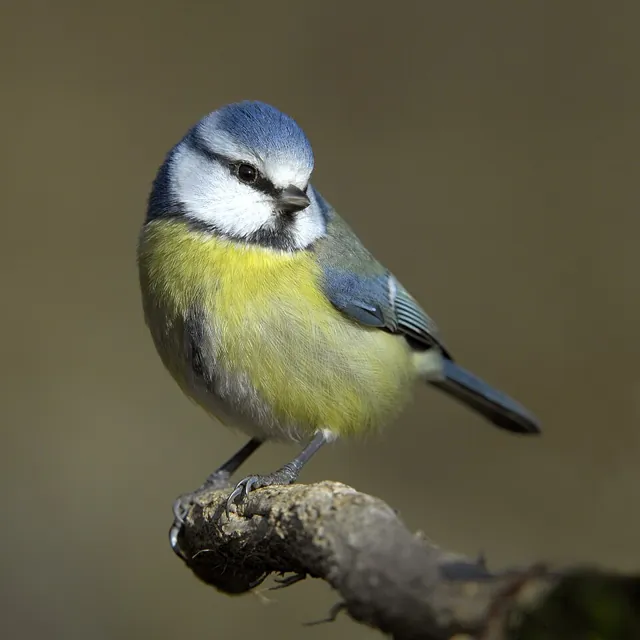
Blue Tit (Cyanistes caeruleus)Where and when to see it in the UK
Resident · reporting peaks November to April · Tits, Chickadees, and Titmice · BOU category AF
Peak months
Contains OS data © Crown copyright and database right 2026 (grid squares, place names from OS Open Names). Northern Ireland place names: OSNI Open Data, OGL v3.0. County and country boundaries: Office for National Statistics, Open Government Licence v3.0. Coastline: Natural Earth. Bird records from the data partners listed here.
Blue Tit has been recorded in 2,677 of the 2,971 10 km squares covering UK land (90%) in records to 2026. Resident in the UK. Its strongest squares are in England, Scotland and Wales. Reporting peaks in November to April.
Conservation status: Least Concern (IUCN Red List, LC)
View on the IUCN Red List- Very high
- 71% or more of visits
- High
- 54% to 71%
- Moderate
- 34% to 54%
- Low
- under 34%
- Surveyed, not recorded
- at least 20 qualifying visits, no record
- Insufficient records
- too few visits to say
- Lighter fill
- Few visits, lower confidence
- Small dot
- Occasional: a single record, or out of season
Relative to this species' best squares (how classes are calculated)
Seasonality
| Month | Relative to peak | Share of visits | Typical class |
|---|---|---|---|
| January | 96% | 61% | Very high |
| February | 100% | 63% | Very high |
| March | 99% | 63% | Very high |
| April | 95% | 60% | Very high |
| May | 76% | 48% | Low |
| June | 68% | 43% | Low |
| July | 63% | 40% | Low |
| August | 71% | 45% | Low |
| September | 76% | 48% | Low |
| October | 80% | 51% | Very high |
| November | 89% | 56% | Very high |
| December | 95% | 60% | Very high |
Squares with the highest reporting rate in January
| Square | Where | Share of visits | Class |
|---|---|---|---|
| C62 | Causeway Coast and Glens, Northern Ireland | 100% | Very high |
| C73 | Causeway Coast and Glens, Northern Ireland | 100% | Very high |
| C90 | Mid Ulster, Northern Ireland | 100% | Very high |
| C93 | Causeway Coast and Glens, Northern Ireland | 100% | Very high |
| D00 | Mid and East Antrim, Northern Ireland | 100% | Very high |
| D13 | Causeway Coast and Glens, Northern Ireland | 100% | Very high |
| D23 | Causeway Coast and Glens, Northern Ireland | 100% | Very high |
| D31 | Mid and East Antrim, Northern Ireland | 100% | Very high |
| H15 | Fermanagh and Omagh, Northern Ireland | 100% | Very high |
| H76 | Mid Ulster, Northern Ireland | 100% | Very high |